By Susan Cushing
Published in the November 2024 Issue of Memento Mori
In the quiet moments after the battlefield, when the echoes of war fade and the uniform is folded away, a new mission begins for U.S. military veterans: the journey back to civilian life. This transition, often marked by a mix of pride and uncertainty, is a testament to their resilience and the strength of the human spirit. As they navigate a world that has moved on without them, these veterans carry not just the memories of their service, but the enduring values of sacrifice, honor, and duty—values that guide them as they forge new paths in a land they once fought to protect.
Not every veteran has faced the trauma of the battlefield. Many serve in vital supportive roles, often far from the immediate dangers of gunfire and explosions. Yet, their contributions are no less crucial to the survival of our nation and the preservation of the freedoms we cherish. Each veteran’s work, whether on the front lines or behind the scenes, is a testament to their commitment to protecting the values that define us.
U.S. military veterans, with their unmatched work ethic, leadership, and problem-solving abilities, represent some of the best potential employees. Yet, despite these incredible assets, many struggle to find civilian careers that are both fulfilling and accommodating. The rigid structure of a 9-to-5 job often clashes with the adaptability and intense experiences they’ve had in the military.
Moreover, the psychological scars, such as post-traumatic stress disorder or PTSD, make it even harder for them to reintegrate into a work environment that doesn’t fully understand or support their unique needs. This creates a paradox where some of the most capable individuals face the greatest difficulties in finding suitable employment.
Suitable Career Paths
Since the official end of the Great War, now known as World War I, on November 1, 1919, America has set aside a specific day to honor the service and sacrifices of our veterans. As we commemorate their contributions to our nation’s security and freedoms, it also presents an opportunity to reflect on the unique challenges many veterans face as they transition back to civilian life. In this month’s issue of Memento Mori, we honor their service while also exploring the difficulties of reintegration, shedding light on the support and resources they need to thrive beyond their military careers.
Interestingly, we have found that the deathcare profession stands out as an exceptionally well-suited career path for returning soldiers. For a variety of reasons, this sacred field offers the warmth, sensitivity, and empathetic mindset that many veterans need as they take those tentative first steps into a new phase of life.
We were fortunate to meet several fascinating individuals whose personal experience proves how perfectly the worlds of military service and the funeral profession intersect. These wonderfully strong and courageous individuals generously offered to share their stories, and we proudly share them with you.
“The deathcare profession saved my life.” These powerful words come from a man whose face and name are familiar to many, and certainly to members of ICCFA. Andy Lopez, a proud USMC Veteran, co-chair of the ICCFA Veteran’s Committee, and board member of Wine Country Marines, proudly served his country then faced the challenges of life out of uniform.
Andy generously shares the details of his own return to civilian life, and how, after finding a firm footing, began reaching back to help others making the same journey.
“Purpose is what we’re driven by,” he says. “You’re defined by the uniform that you’re wearing. Upon leaving that role, finding purpose again—that place where you can serve—can literally be a matter of life and death. Without that sense of purpose or identity, that’s where you see vet suicides become a factor. That’s why you’ll so often hear veterans say, ‘If I didn’t have this, I don’t know what I’d do.’”
A former Marine, Andy knows too well how difficult the transition from military to civilian life can be. This is one of the reasons he’s been such an active and pivotal member of various committees and boards that serve to support and advise fellow veterans.
An exciting and engaging speaker, Andy has received wide acclaim for presentations such as “Journey to Serve” and his YouTube video, “The Power of Grit: Lessons from a Marine and Businessman.” In his current role as chief revenue officer for SoCal Approach Marketing and Consulting Group, Andy’s daily interactions involve both veterans and individuals working in the funeral profession.
“When I speak to veterans, I have to remind them, they no longer have training wheels,” he says. “There is no longer anyone telling you where to be or what to do. This is real life, now you’re responsible for all your actions. You no longer have a team working with you, and it’s a lonely place to be.”
Helping veterans find a new path usually begins by asking what they enjoyed most during their military service, Andy says. From there, they can usually discover a new career that will utilize the skills they’ve acquired and find a job that is both rewarding and serves as a new purpose.
Purpose is precisely what Andy has found for himself in his ongoing efforts to help fellow veterans. In fact, he referred to a recent post where he quotes something acclaimed actor Denzel Washington once said.
“Essentially the quote was, ‘The most selfless thing we can do, is to do something for someone else’,” he says. “That’s why I try to help the military veteran. It just feels good. I feel so passionate about this because I truly believe we can save more veterans by providing them with opportunities. I love our profession and believe it can be the salvation for many veterans as they transition from military service.”
Another familiar ICCFA face and name, Gwen Mooney, CCFE, while not a veteran herself comes from a family with a long history of military service. She’s seen first-hand the repercussions that come when there is a gap between a career in the military and reentering life as a civilian.
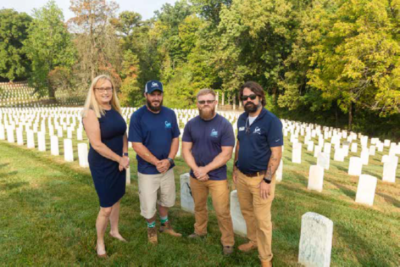
Pictured here (L-R): Cave Hill Cemetery’s Gwen Mooney CCFE, Jason Westbrook, Michael Heusel, and Brian Myers.
“Throughout my career in the funeral profession I’ve always retained very strong ties to the military,” she says. “Understanding the complexities of finding a life upon leaving the military, as well as having a strong appreciation for the fine qualities military men and women seem to possess, I’ve always found that veterans are a wonderful fit for our profession and continue to consider them to be among our best employees.”
Currently, Gwen serves as president and CEO of Cave Hill Cemetery in Louisville, KY, but is also a board member with the Kentucky Vietnam Veteran’s Memorial and an active ICCFA Educational Foundation board member working on Journey to Serve.
“My father was in the Navy, I have two nephews who are Army Rangers who have become very high ranking, both serving in Iraq and Afghanistan,” she says. “Since my earliest days working with cemeteries, I’ve been involved with major projects that address the fact that there are so many Vietnam soldiers who, having died during that conflict never received markers for their graves. In a couple of those situations, I was able to appeal to the Pentagon and help the families of these men and women get the much-deserved markers.”
In one instance, Gwen worked closely with Vietnam Veteran Duke Heller whose own story is one of honor and heroism.
“During the battle, Duke’s buddy Eddie Van Oliver, Jr. was mortally wounded,” explains Gwen, “and Duke, himself wounded, wrapped his comrade’s body in a tarp and carried him for nearly a week, to get him out of the jungle to a base camp so that he could be sent home.
“Duke and I have become good friends and still stay in touch,” Gwen adds. “He now lives in Florida. Duke is getting ready to go to Washington, D.C., to receive the Navy Cross. I will be attending the Ohio ceremony for him recognizing his award. Working with Duke was the event in my career that let me know that I should be working with and supporting our veterans.”
Through Gwen, we were introduced to veterans who have found a new home in the funeral profession. Many of these people were hired by Gwen herself.
One of several veterans now working at Cave Hill Cemetery, Brian Myers served in the U.S. Navy 2009–2013, with two deployments of active duty and 11 awards for his service. He served on two different destroyers, the USS Bainbridge—DDG-96 (Norfolk, VA) and USS Cole—DDG-67 (Norfolk, VA).
“I was an armory guy,” he says. “I was what they call a Quad Ball. I didn’t have a specific thing, I was in charge of the armory, which included everything from 9mm pistols to 25mm canons and I was the only torpedo tech on board.”
A man who had risen through the ranks quickly carrying incredible responsibilities, Brian, like so many others, seemed to be at loose ends upon leaving the Navy.
“I stayed in Virginia for about 12 more years,” says Brian, “bouncing back and forth between jobs. I couldn’t seem to find the right thing; because of my experience in the Navy as a Gunners Mate, I became something of an expert on weapons; but in civilian life, there are only a couple of routes you can go with that background.”
After a series of odd jobs, it seemed Brian had finally found a spot that felt reasonably comfortable. It was with a company associated with Coors Brewing with night clubs in various cities.
“These clubs were called PBR,” he explains. “I started out as a busser and got all the way to head bar back. Once I got there, they offered me the opportunity to be either assistant general manager at a PBR here in Kentucky or operations manager at the PBR in Kansas City. I chose the spot here in Kentucky.”
Brian moved to Kentucky and had just begun getting settled in when COVID hit, shutting down everything, especially places such as PBR. A year-and-a-half of unemployment followed. Fortunately, just before things began shutting down, Brian had made some well-connected friends including Dalton Mooney who happens to be the youngest son of Gwen Mooney.
“He invited me out one night for his birthday celebration and that’s when I met Gwen,” Brian explains. “Of course, at that time I knew nothing about what Gwen did or her many amazing accomplishments, but she was very kind to me asking me about my background and what I was doing at that time. Of course, I explained my situation. A couple of days later her son gave me a call saying, ‘Hey my mom wants to talk to you.’”
As Brian describes it, his job at Cave Hill Cemetery, is just about as close to perfect as any position can be. “I came in as an assistant, and now I’m just about to hit my four-year mark and I’m the Head Sexton. Not only is this a great fit for my experience, but it’s something I really enjoy. You know, working in the nightlife industry, being able to make customers smile, speaking to them the right way, that was something I enjoyed; and here, some of those same things come into play. Of course, it’s different, now rather than interacting with folks out for a good time, I’m dealing with grieving families. Yet, in many ways it’s the same thing, knowing how to relate to them. What to say and how to say it. I feel it’s important to reassure them that their loved ones are being well taken care of and that everyone here will be treating their loved ones with respect and care.”
In addition to his work family, Brian is happily looking toward his future. Engaged, he and his fiancé and her two children are building a life together in Kentucky.
Both recipients of the Purple Heart, one of our country’s highest and most prestigious military medals, Michael Heusel and Jason Westbrook are two proud veterans who have found new beginnings with the Cave Hill Cemetery family.
After completing two tours and seven years of dedicated service with the Army serving in Operation Enduring Freedom, Michael continued to feed his apparent drive to serve by immediately enlisting in the Kentucky National Guard.
Like so many other veterans, Michael explored a variety of positions trying to find the right path for the next phase of life. Through serendipitous events, much like Brian, this dedicated veteran was introduced to people affiliated with Cave Hill Cemetery.
“Another veteran who I had become friends with as I explored various career options, introduced me to Sarah Shaffner,” he says. “Meeting her literally changed my life. I got my foot in the door with Cave Hill working with the landscaping crew. Seven years later and I’m now the head gardener and couldn’t be happier. I work with wonderful people and my ‘office’ is the great outdoors. What could be better?”
Responsible for more than 12 acres, Michael emphasizes how enjoyable his work is. Even more importantly, it’s work that he believes is ideal for returning veterans particularly those who have experienced excessive trauma while serving their country.
“For some reason, this line of work is almost therapeutic,” he says. “I know I’m not the only one who feels this way. It’s especially good for those suffering from PTSD and other psychological issues. It’s more of a peaceful, work-at-your-own-pace kind of job. You never feel like someone is hanging over your shoulder; they trust you to get the job done without micro-managing.”
Although he’s engaged, Michael and his bride-to-be, like so many others, had to put wedding plans on hold due to COVID, but he says the big day is definitely in the near future.
Michael has nothing but high praise for Gwen Mooney who he says has been instrumental in so many lives, helping veterans find their way back to civilian life.
“I don’t work directly under Gwen,” he says, “but I really appreciate what she does for us. I know she’s made a difference in so many lives.”
Army Veteran Jason Westbrook’s service also included playing an integral role in Operation Enduring Freedom (Afghanistan; 10th Mountain Division). After four years of active duty, Jason, like so many others, returned home unsure of what his next move might be.
He returned from war bearing scars—both physical and psychological. Purple Hearts aren’t simply given; they are earned by those who have endured some of the most harrowing experiences of combat. For Jason, November 6, 2006, was the day a rocket-propelled grenade claimed three-quarters of his right hand and left him with shrapnel embedded in his neck and face.
As Jason explains, he became part of the Cave Hill family through a VA program. “Through various partnerships, this program helps veterans find suitable jobs,” he says. “I was placed in a position at a local cemetery called Zachary Taylor and really enjoyed the work and the people I worked with. Unfortunately, that program only lasted for nine months. Realizing that I found something I really enjoyed, I applied at Cave Hill Cemetery and was hired on the spot. That was five years ago, and I have been extremely happy. I love it there because it’s the closest I’ve come to the type of brotherhood that I had in the military. It’s also the closest I’ve come, since the military, to experiencing a secondary family.”
Jason’s role today is one of the most solemn. Interment service calls for quiet dedication and respect. “I believe my time in the Army and the skills I acquired have been helpful in this position.”
Also, like Brian, Jason strongly encourages other veterans to consider seeking employment in the funeral profession. “My time in combat messed me up pretty bad,” he says. “My work here, and especially working with these great people, has played a big part in helping me overcome some of the worst aspects of PTSD. I would recommend this profession for those who’ve gone through similar experiences.”
Not all military veterans moving into the deathcare profession work at funeral homes or cemeteries. Some, like retired U.S. Army Colonel Jack Lechner, Jr. CFSP, share their experience and knowledge in the world of education helping to train tomorrow’s deathcare leaders.
Jack began his military career in 1983 as a private, enlisting in the infantry. After 29 years of active duty, he retired in 2011 with the rank of Colonel. Upon leaving the Army, Jack turned his attention toward education and today serves as president of the Cincinnati College of Mortuary Science.
Deathcare was not new to the Colonel; he had served as a funeral director before enlisting. “I started with this profession right out of high school,” he says, “and was very involved for about 10 years. At that time, I had the wild notion that I needed to see the world, so I enlisted in the Army.”
As a veteran now of both the military and the deathcare profession, Jack’s perspective is a unique one. “I think the two complement one another,” he says. “You know, to work in this profession you need to be flexible, willing to work any hours and you need to be focused and conscientious. There’s no do-over, which is very similar to what the military demands.”
Such an accomplished and highly respected man, the military did not want to let Jack go. Just one day after his retirement ceremony from the Army, the Colonel was asked to rescind his retirement orders and take on a critical assignment at Arlington National Cemetery. In June 2010, he joined a new leadership team tasked with restoring the cemetery’s honor in the wake of a major scandal that same year. Over the next five years, he served in key roles, including executive officer, cemetery administrator, deputy superintendent, and ultimately, as Superintendent until August 10, 2015.
Not surprisingly, Jack encourages other veterans returning to civilian life to seek employment in this wonderful service profession and has hired several himself.
“Vets are great employees because they show up to work on time, know how to take orders and that fits very well with being a funeral director,” he says. “And, what the deathcare profession can offer veterans is the fact that it’s so multi-faceted you can be part of a funeral home, cemetery, or crematory and there are so many different ways to serve. There’s everything from embalmer to crematory operator, grounds crew, or one of the many other positions. It takes a lot of dedicated people, and it seems there’s virtually something for everyone.”
One of the many veterans Jack has hired over the years, is Samantha Legendre, retired from the U.S. Air Force and now serves as the registrar at the Cincinnati College of Mortuary Science (CCMS). Energetic and dedicated, Samantha served as an aircraft fuel systems mechanic while in the Air Force.
She earned her Bachelor of Mortuary Science degree from CCMS a few years ago and became a licensed funeral director and embalmer in Ohio. Long before enlisting, Samantha knew she wanted to be part of the deathcare profession. Sadly, her motivation and passion for this profession was born of a tragic situation she faced as a young girl.
“I guess I’ve known since I was about 9 this was the work I wanted to do,” she says. “It came about because my dad died in a car accident, which resulted in my growing up well below the poverty line. Because of our financial situation, the only option at that time was direct cremation. Unfortunately, my mom didn’t understand the importance of viewing and closure and I didn’t get a chance to see my dad.
“Obviously, his body probably wasn’t in the best condition, but I really felt like I needed to see him to say goodbye,” she continues. “Not seeing him or getting that closure had a huge impact on me. It grew in my mind that when I was older, I wanted to be that person to give families that closure that I wanted so badly. It became my life’s passion. His death gave me purpose and I thank him for that; otherwise, I wouldn’t have the same appreciation for him. He was a drunk driver so I think we might have had a very different relationship, so in many ways this was a blessing. He gave my life a drive and a passion for a career that I really love.”
Like other veterans we spoke to, Samantha believes that military service offers a great springboard for the deathcare profession.
“I’ll admit this is a tough profession, physically and mentally,” she says, “and I feel my military background serves me well. I’m prepared for the hard work and discipline that is required. I think this is definitely a good fit for veterans for these reasons.”
And she has found closure. “Personally, I feel my work has given me the closure I sought as a child, and I enjoy being able to help others get that sense of peace. It means the world to me. It’s been a wonderful journey for me.”
Helpful Heroes
A consistent theme emerged from every story we heard: the peaceful, rewarding, and deeply fulfilling nature of work in the deathcare profession. Veterans, in particular, are uniquely suited for this sacred field, bringing with them the work ethic, discipline, and dedication they cultivated during their military service.
We extend our gratitude to all those who shared their experiences with us—not only for their service, but for helping us uncover the remarkable career opportunities this profession offers to veterans.
Susan Cushing is a regular contributor to Memento Mori magazine.